
Building the Disruption: How a classic Industrial Revolution Simulation Got a US History Sequel
For three days, my US History students stared at two words on the whiteboard in the midst of their unit on the Industrial Revolution. Each day had a number next to it.
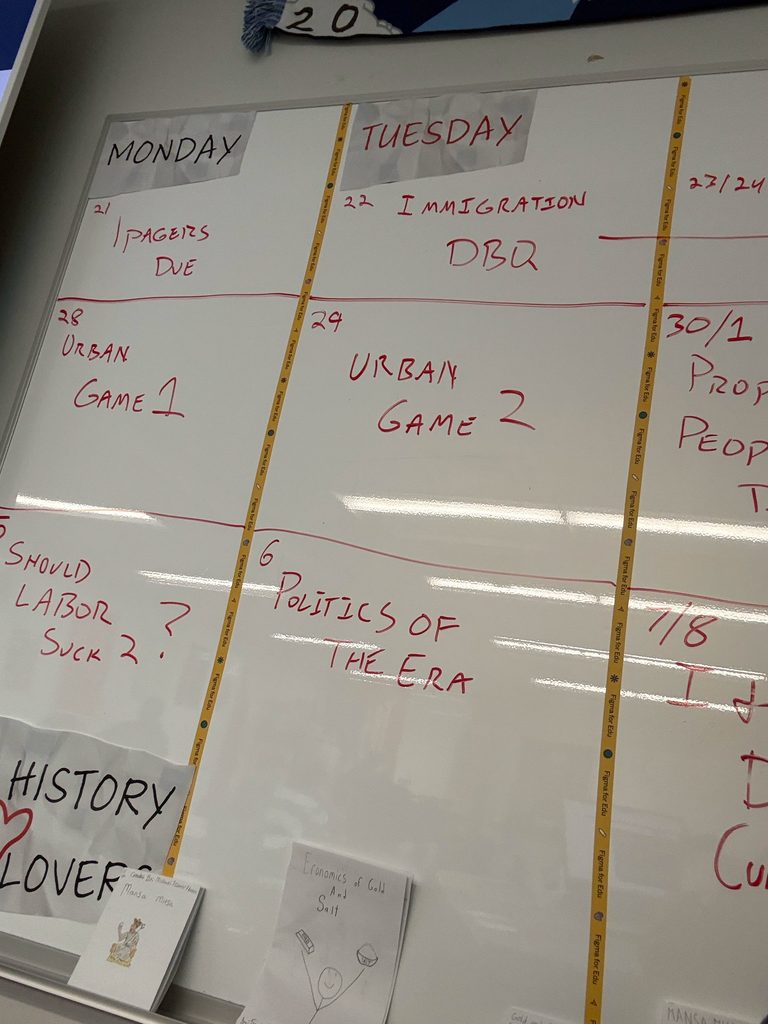
I heard murmurs. Quiet ones. Nobody wanted to get excited until they were sure what it meant.
We started a day late on Tuesday so we could finish DBQs. When they walked in to start connecting the Industrial Revolution to Urbanization, this was on the screen:
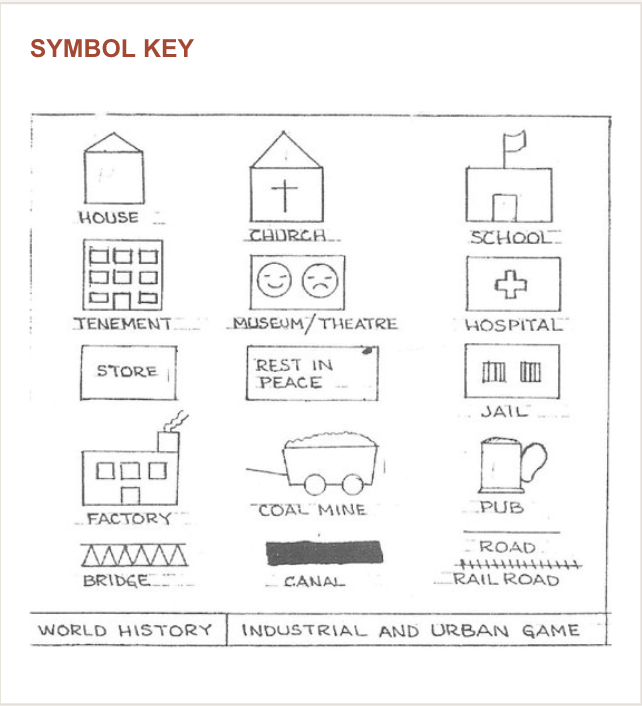
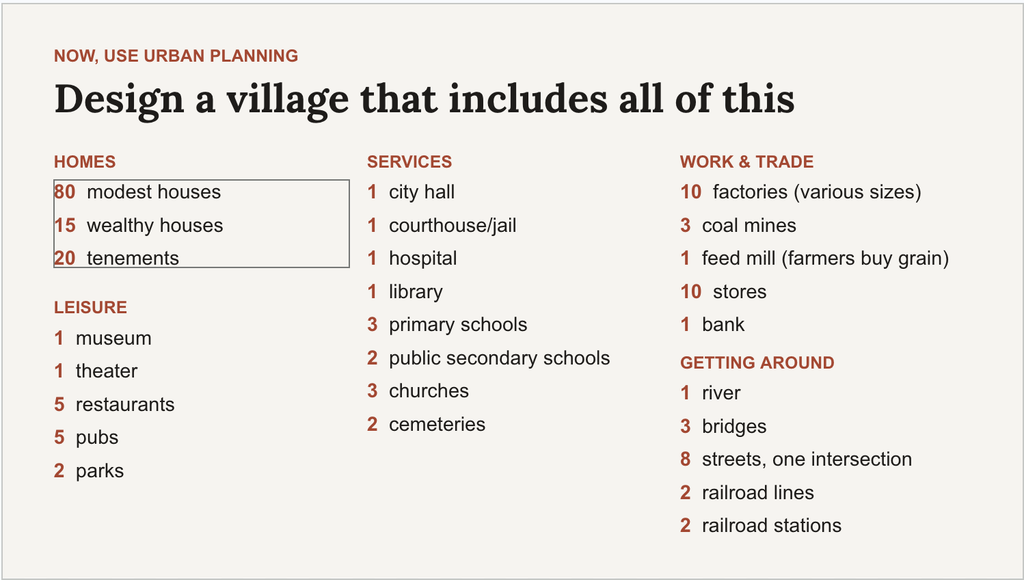
The murmurs broke. Instantly. Students were swapping memories from World History the year before: the canal round, the cemetery that kept growing, the village that turned into a disaster by 1850.
Then they got confused.
They recognized the symbol key. But why were they starting with the checklist of everything a city needs? Why did they get to plan? The whole point of the Urban Game is sprawl and chaos.
Because the Urban Game, as much as we love it, teaches the Industrial Revolution in Europe. I wanted to take that same activity and use it to teach the Second Industrial Revolution in the United States.
So we started at the end. Every student designed their ideal city from scratch, down to the parks and the post office. Schools where they wanted them. Houses with room to breathe. They were proud of those maps.
They had no idea what was coming.
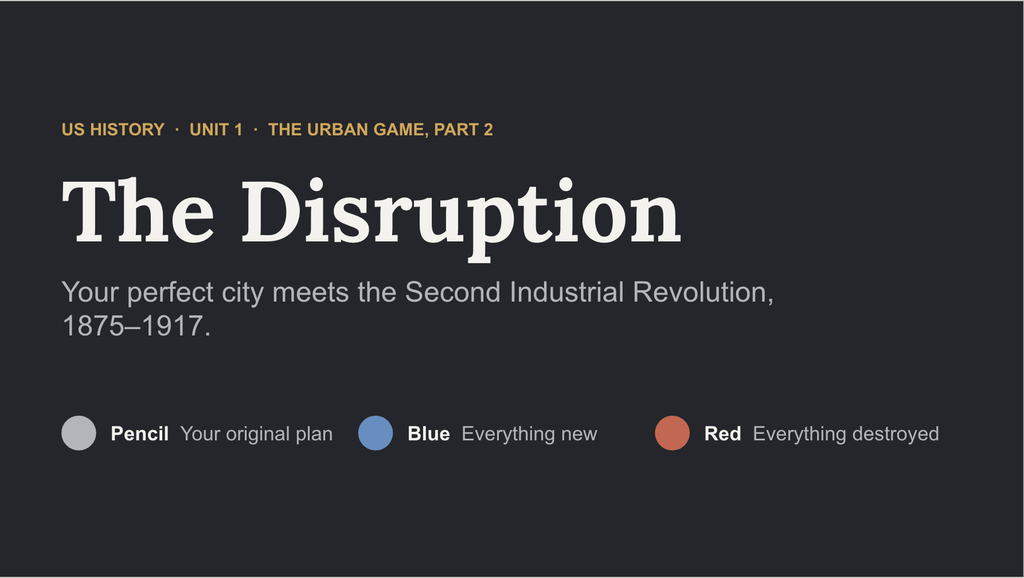
If you’ve never run it, here’s the short version. Students draw a quiet English village in 1700. The teacher reads twenty rounds of real history: canals, the Enclosure Acts, the water frame, steam, child labor, railroads, the Irish famine. Each round adds factories, tenements, pubs, jails, and cemeteries. The rounds speed up. The village chokes. Students witness the Industrial Revolution at a sped up pace.
It’s a classic for a reason. It’s been passed teacher to teacher for years, usually in a folder from someone down the hall.
But it builds a city up from nothing. I wanted to take one my students already cared about and let 1875 happen to it during the Industrial Revolution.
The Disruption (America’s Second Industrial Revolution)
The Second Industrial Revolution didn’t ask anyone for permission. Railroads didn’t go around neighborhoods. Steel mills didn’t hold town halls. Zoning showed up after the damage was done and called it a plan.
The Disruption is a 17-round simulation running from 1875 to 1917. Each round is a real event: the Edgar Thomson steel works, the railroad and eminent domain, Pearl Street electricity, new immigration and the Chinese Exclusion Act, the first skyscraper, streetcar suburbs, Hull House and Jacob Riis, Homestead, the Panic of 1893, U.S. Steel, the Tenement House Act, The Jungle, the Triangle fire, Ford’s assembly line, the Great Migration, New York’s 1916 zoning law, and wartime production with the literacy test.
And every round lands on a map students already love.
Designing for loss of control in the Industrial Revolution
Reading about powerlessness is one thing. Watching a classmate draw a railroad through your school is different.
Every rule in The Disruption is there to make students feel the loss of control, not just learn the vocabulary for it.
Nothing floats. New buildings have to fit on the existing map. If they don’t fit, students demolish something, and they pick what. That choice tells you what they value faster than any survey.
Three colors, one record. Pencil for the original plan. Blue for everything new. A red X for everything destroyed. By 1917 the map is a picture of what happened.
The Disruption Ledger. On the back of every map is a table: what was destroyed, who lived or worked there, and who made the call? That last column runs the whole debrief. Whose actions during the Industrial Revolution harmed real people?
Then the rounds start taking the pencil away.
- The neighbor round (1877). Students pass their map to the left. A classmate lays a ruler across it and draws a straight track. Everything it touches is gone. Nobody needs a definition of eminent domain after that. They’ve lived it.
- The choice round (1892). Students own the Homestead mill. Negotiate with the union or lock them out? They commit first. Only then do they learn what Carnegie and Frick actually did.
- The dice round (1893). The Panic. A die decides how many factories close. You did nothing wrong. Doesn’t matter.
- The partner round (1901). Pairs compare factory counts. The bigger industrialist writes their initials on the other’s factories. U.S. Steel, explained with a pencil and one smug classmate.
- The move round (1888). Streetcar suburbs. The wealthy houses run to the end of the line, and the mansions they leave behind become tenements.
- The re-plan round (1916). Students zone their city and count how many buildings now sit in the “wrong” zone. It brings them back to where they started: the plan. Only now the plan is a cleanup job.
Two rounds break the pattern on purpose.
The Triangle Shirtwaist Fire (1911) has no dice and no mechanic. It’s a moment of silence. 146 people died. That is not a game, and the slide doesn’t pretend it is.
The Great Migration (1916) has a catch. Ten new houses arrive, and restrictive covenants force all ten onto one block by the tracks. Students don’t get a choice. That’s the lesson. Northern segregation wasn’t an accident of geography. It was drawn.
It always lands on real history
Every round slide has a “What really happened” panel. The game is the hook. The history is the point.
It fits the district’s Unit 1 sections on Industrialization and on Immigration & Urbanization, and it feeds the unit’s big question: What does it mean to be an American? Who is included? Who is excluded?
If you read the Year Zero post, you’ll see the family resemblance. The World History Unit 1 kit ends on “who gets to decide which civilization was resilient?” This one ends on “who got to decide what your city became?” Same question. Different century. Turns out I keep asking it.
It’s also a natural fit for I Used to Think / Now I Think from the Project Zero series. “I used to think my city was mine.” Let them finish that sentence.
The AI part (it’s smaller than you think)
I built this with AI across three sittings. Here’s what that looked like.
It started small. I had a dated Urban Game PowerPoint (black textured background, WordArt “Round 1” titles, web images of mixed quality) and a long Google Doc script.
Step one was simply modernizing it: 27 slides rebuilt in soot black and brick red on off-white, one consistent layout per round, and the public domain primary sources kept (Cruikshank, Hogarth’s Gin Lane, Lewis Hine, Mulberry Street). We added a “How to play” slide, fixed the symbol key, and sorted the final checklist into categories.
Then I asked about a US History version. The AI offered three directions: a live shared class city, a solo digital builder, or a souped-up paper game.
I said none of those. My kids already have cities. Let’s wreck them.
That’s the part I want other teachers to hear. The big idea came from the classroom, from knowing what my students had already done and what they cared about. The AI’s job was turning that idea into mechanics, slide design, accurate history, and a read-aloud script built like the original, down to the staging notes (“hold the Homestead reveal until they’ve chosen,” “slow down for Triangle”).
It also fact-checked. Dates and claims were checked against sources: the Richmond streetcar, the Tenement House Act, Homestead, covenants, NYC zoning. Where the numbers are disputed, like the exact Homestead death toll, the script stays general and doesn’t invent precision. I’ll take an honest “about” over a confident wrong number. (This is honestly the piece that took the longest, making sure dates and locations were accurate).
One more thing. The sequel deck has no photos yet because the image library was blocked during the build. Each round gets a bold year panel instead, with space saved for Riis, Hine, and Triangle images. Sometimes constraints make a cleaner slide. Sometimes they just leave you with homework. I was too excited to share it with students to add the photos now, but when we finish, they’ll get that version to look at too!
AI as a thinking partner, not a shortcut. You’ve heard me say it before. This is what it looks like on a Tuesday.
Steal this
Don’t reinvent the classic. Remix it. Take the lesson every teacher in your building has already run and ask what it would look like if it happened to your students instead of in front of them.
They built perfect cities. History didn’t care.
That’s the lesson.